Showing posts with label Global temperatures. Show all posts

Thursday, July 4, 2019

The world is melting...the world is melting....Part one.


I saw an NBC article

Where global warming supporters  made the clam that "a strange, wavy jet stream  is blasting Europe with heat. Scientists say this could be the 'new normal" They use words like profound, unusual, extreme.

Denise Chow (writer and editor at NBC News) wrote:  " An oppressive heat wave baked Western Europe this week, setting record high temperatures in France, Germany, Poland, and the Czech Republic. In India, a severe drought has choked water supplies in the city of Chennai, exposing it's 9 million residents to a major shortage. And after the United States wettest 12 month stretch on record, towns across the Midwest and the Great Plains are reeling from devastating floods".  She also wrote, " The reasons behind these extreme weather events are complex, but scientists believe they have a common trigger: profound recent changes in the set stream, a ribbon of fast-moving air that flows from west to east over the Northern Hemisphere and controls weather systems".

These so called extreme weather events find their way into mainstream and social media all the time. The catch phrase now is climate crisis. Media is talking about Japan seeing its warmest recorded temperature in history of 106°F. How Montreal has seen temperatures approach 100°F. Toronto has seen 18 days that exceeded 30°C, Forest fires in Siberia and Europe are the worst in history, and so on and so on.   

The predictions:

Tornadoes:

The number of tornadoes this year are being blamed on climate change.  But that is simply not true.  Looking at the tornadic trend for 2019 we see it's below 2008 and 2011, both of these years had a lot of cold air in Canada and northern tier of CONUS during May.  For tornado outbreaks to occur the prime requisite is cold air from the Rockies into the Great Lakes, sitting over warm air farther to the South .

 
Above images curtesy of the Storm Prediction Center.

Tropical cyclones:

In the Pacific Hawaii is going to see a lot of action heading their way.  Again the media, will say its global warming is the reason.  supporters of global warming will take that and run with it.  But again it won't end up being true. 

One of the latest global warming idea trends is that tropical cyclone rapid intensification is caused by global warming.  But again that is a gross exaggeration of the facts and what is really going on.

Back in June of1988 James E. Hansen from NASA testified before the Senate Committee on Energy and Natural Resources (Hansen is called the father of global warming theory, by many). At the time there was a prolonged heat wave impacting North America (this was the first of two devastating heat waves that summer).  Hansen showed a multitude of climate model predictions, and inferred " He had a high degree of confidence, that there was a cause and effect relationship between the greenhouse effect and the observed warming" During his testimony, he said, " The globe would see a significant warming over the next 25-30 years" He also stated " the 1990 into the 2000's would see much greater than average warming in the Southeast US. and in the U.S Midwest"  No such spike in temperatures has ever been measured. Over the ensuing years he talked about how CO2   was the main culprit, and many more predictions, hurricanes would become increasingly more powerful, Hurricanes would cause increasing more and more damage in the US, tornadoes would become stronger, and the biggest one was in 2007 when he said " the Greenland ice sheet would be completely melted soon, resulting in a rise in the global oceans of 23 feet". He made dozens of other claims.  But looking back at these all of these predictions show none of them have come true. Over the last few years snow and ice amounts have been increasing in Greenland, Hurricanes aren't more powerful than the historic record shows for past hurricanes, Based on the gross domestic product index, hurricanes aren't causing greater amounts of damage (even though the coast is becoming more and more developed). Tornadoes are not becoming more frequent or more powerful than tornadoes of the past.  The list of what didn't occur is long and tedious.  

10 years ago, the media was alight with the talk of perma-drought in California  and the Southern Plains into the Midwest. The climate warming alarmist said perma-drought was here to stay with no  end in sight, that human caused climate change was the reason and that a new dust bowl era had started. But this kind of talk isn't decades old, as resent as 2015 Katherine Hayhole declared that "permanent drought was the future of Texas panhandle and that the nations beef would get increasingly strained".   But none of these predictions came true. Just two to three years after Hayhole's prediction. The same areas that were to have perma-drought, are now overflowing with water. As for California, in 2014 Gov Brown, said perma-drought was the new normal for 40 million people who depend on the Colorado Rivers water" as of the end of June, the upper Colorado River basin had a snow water equivalent of 425% of average. I would say the fear of a perma-drought in California has been erased.

Al Gore has made many of these same claims in his book "An Inconvenient Truth" and in a more recent movie.  It remains to be seen if any of his claims will become true.

To be fair, there are global warming deniers, who go off the scale on the other side of this debate, but it seems to me that they are outnumbered by the global warming supporters.  The current debate is saturated with junk science. We need to get the junk science and politics out of the debate, if we truly want to understand what is going on....   

 Looking at some data:

 We are only 4 days into the month of July and the reports of all time record heat are flying all over the place.  We hear about record heat in Europe,  Miami, FL has had two almost 100 degree days for the first time ever in a single year. Record breaking heat in Alaska. 

When I was at A&M I remember been taught that the highest global temperature ever recorded was 136 in El Azizia, Libya, back in Sept. 13, 1922. But that temperature record was thrown out in 2012.  There have been a bunch of other very hot temperatures thrown out too.  It's hard to refute something if many of the true facts aren't around anymore.

When we look at the current global  2-M temperature anomaly we see it's 0.310 °C above average, With the CONUS 2-M temperature anomaly 0.121°C above average.  When we look back at past decades there were years that saw higher temperature anomalies and lower temperature anomalies. When we look at the overall temperature pattern over the last 40+ years there is no doubt that global temperature anomalies are rising.  But clearly the world isn't burning up (as many in the past have predicted it would be). I mean really, a 2-M global temperature anomaly of 0.310°C isn't a huge difference. There has to be enough compensating colder areas to keep it close.
 
Above image courtesy of WeatherBell Analytics
 
Averaging out year to date, finds the eastern half of the CONUS has been cooler than average. This is a change from last year.

Above image courtesy of WeatherBell Analytics

Current Maximum daytime temperature anomalies are  0.97°F above average


Above image courtesy of WeatherBell Analytics
 
Current minimum nighttime temperature anomalies are  2.0°F above average


Above image courtesy of WeatherBell Analytics

The temperature anomalies for the CONUS are well above average. By looking at the daytime and nighttime anomalies we can clearly see most of the temperature anomaly difference is because of very warm nighttime lows.

When we look at the global temperature anomaly map we see the vast majority of the warmth is near and in the polar regions. whereas the temperate regions (where we and everything else lives) is a mixture of warm and cool areas, that seem to balance each other out. So clearly, the heat in the polar regions is a major reason for the above average global temperature anomaly.

We can see how the poles react during the northern and southern hemisphere summer season and winter season.

We see the poles have warm temperature anomalies during the arctic cold season, but cooler temperature anomalies during their warm season. What could be the reason for that?

So while I agree that the global temperatures are gradually increasing. I disagree with the idea from global warming alarmist as to the cause of the current warming.

 What could be causing the warming?


The reasons I think the globe is warming will be covered in part two.


Sunday, July 29, 2018

Are Sea Surface Temperatures and Global temperatures really increasing?


Teleconnection in the Atlantic.

I posted the other day on my Facebook weather page on the current weather pattern. In the post I talked about the cool SST in the Atlantic, and the developing El Nino Modoki.  The Atlantic Multi-Decadal Oscillation (AMO) looks to be heading into its negative (cool) phase. In my post I also talked about how the increase in Northern Hemisphere sea ice extent is increasing support the idea of a negative AMO developing.  The AMO is a long-term ocean oscillation that typically last for an estimated period of 40-80 years. We've been in a positive (warm) phase since the mid 1990's.  The AMO is based upon the average SST anomalies in the North Atlantic characteristically  between 0-80N. It's been 23 years since we officially started into the AMO positive phase. So given that the AMO has a general period of 40-80 years, we're clearly within range for a switch to negative phase. We've seen in the past how the AMO can quickly go from one phase to another.

The AMO cycle involves changes in the north to south circulation and overturning in the Atlantic Ocean. The warm Gulf Stream Current off the East Coast of the CONUS is an important part of this overturning process. When the overturning circulation decreases, the North Atlantic SST become cooler. When I mentioned how the sea ice and Greenland ice and snow are increasing, it caused confusion and doubt for some who read it.  All of this led to me deciding to post on global temperatures.  I've posted in this blog more than a few post involving global warming and climate change. I've stated how I'm not convinced that humankind is the primary driver in any global warming process.  The post is going to be on SST and global temperatures. The post isn't meant  to show how/or how not global warming is occurring. But it deals with global climate so it does touch on the same subject. The following is a very complex subject. But I've tried to put it into plain speak.

Part one: the basics of how all this works.

We're seeing a rapid change in the Atlantic SST. Both the tropical Atlantic and the far north Atlantic have cooled off dramatically. But the Atlantic isn't the only place we're seeing ocean cooling.  The Pacific and the Indian Oceans have also seen cooling. Here are comparisons between SST in 2015 and 2018.

 
It's plain to see there has been a big reversal. Over 70% of the Earth's surface is covered by water; that is a lot of surface area. 97% of all surface water is in the oceans. Clearly the oceans are important.  The climate is driven by the Sun and the oceans. The Sun's energy comes to Earth through solar radiation. As the radiation reaches the atmosphere, radiation is absorbed by upper atmospheric molecules; these molecules transfer this and warm other molecules and so on ( a process called conduction) .  At some point, all of this reaches the surface containing land and water.  The oceans have control over the vast majority of the thermal energy on Earth; The total amount available is 99.9 %. Thermodynamics is a complex subject. But for our purpose we will just say, thermal energy is energy that comes from heat. Heat is the process that occurs when thermal energy is transferred from one object to another.  Looking back at the 99.9%, it is clear that the oceans have control of a lot of energy potential. This is important to remember.

The oceans and atmosphere work together in two very important ways. 1st, is through an exchange of heat, water momentum. Because of their size oceans store enormous amounts of energy in the form of heat. Most of the heat is collected along the equator; because of the Earth's rotation ocean currents transfer the warm water poleward. In this way the ocean transports an enormous amount of heat toward the poles. In the Atlantic this is called the Atlantic Meridional Overturning Circulation (AMOC); the northward flow of warmer water and the southward flow of cooler water is part of the Thermohaline Circulation (which is beyond the scope of this post). Anyway, the ocean heat rises and eventually warms the atmosphere. 


The atmosphere is also a fluid and air currents (wind) transfers heat toward the poles as well.  The northward movement moves the air through colder and colder air as it moves toward the poles. Because thermal energy transports heat into a colder environment faster than a warm one.  In this way heat is transported from the low latitudes to the middle and high latitudes.  This poleward movement is called Poleward Heat Transport (PHT), and is accomplished through air mass exchanges, storms, and ocean currents. This is where convection comes in; convection is the rising and falling of air molecules and water particles in the atmosphere and water. When we look in the sky, clouds are a visual aspect of the convective process.  A lot of this heat ultimately goes into outer space.

Part two:  Applying what I  just went over to what's going on.

I know what I posted above was a review of your Earth Science in High School, but I thought it  necessary. OK with the basic science out of the way; I will talk how all that fits into the current pattern.

Referring back to those SST images above, there has been a turnaround in worldwide ocean surface temperatures. Surface temperatures are cooler, but what about the sea temperature underneath the surface? Here is a chart done by, Dr. David Thornalley, department of Geography, University college London. The chart shows how much Ocean Heat Content (OHC) in the North Atlantic has cooled from the Surface down to 2296 feet over the last five decades.


Here is another Chart done by Dr. David Smeed, National Oceanography Centre, Southampton, UK. This shows how much the surface and subsurface temperatures in the North Atlantic have cooled over 30+ years.


Yet another chart, this one done by Dr. Christopher Piecuch, which shows the cooling trend in the Sub-polar North Atlantic (SPNA). We can see how the upper ocean and SST's have reversed from the mid 90's to Mid 2000's to the cooling trend that started around 2005 to 2015.


Clearly this is a huge amount of water, add in the cooling Pacific and Indian oceans and the amount is just plain gargantuan. Appling the processes I talked about, we can see how the PHT and AMOC distribution of the cool water would have an influence on atmospheric heat distribution and in turn the weather.  Those of us who live in the Northeast understand cold, snow, and ice. To me, that cool OHC has to have an impact on arctic ice conditions. 
Here is a chart from the Danish Meteorological Institute (DMI) showing Arctic sea ice volume is at its 4th highest level since June 30,2018. We can see how the volume increased through June.


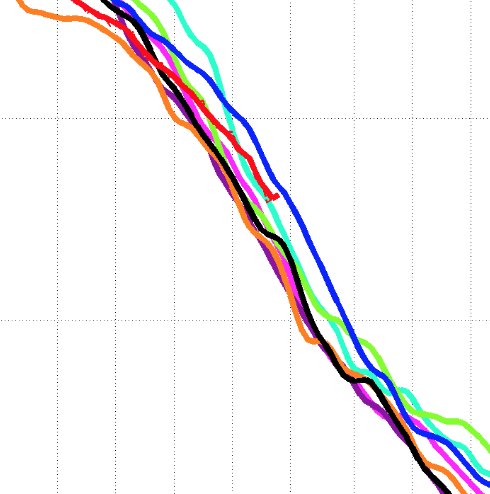
This chart shows how there has be a huge spurt of ice growth in Greenland. The red line turning sharply to the right is 2018


Looking at this chart shows that the Arctic temperature has been below the mean all Summer.


Here is a chart showing the higher than average amount of snow falling on Greenland since late 2017. Also because of the cooler than average surface temperatures, there has been an average to below average melt season.
 

In Conclusion:

This brings me back to my original Facebook post  and the confusion and doubt it raised.  I've shown how the ocean and atmosphere transport heat. And how they work in concert.  Colder ocean temperatures logically lead to cooler air temperatures, which translates to a greater potential for snow and ice growth.  So the idea that ice loss has stabilized and started to reverse shouldn't be that surprising, at least to me. 

The oceans absorb CO2 and heat . The ocean has an incredibility high temperature and resistance to change, relative to the atmosphere.  The ocean circulation system is very slow.  A  storm can make atmospheric changes  in hours and then dissipate. But ,the Oceans  take months, years, and even decades to accomplish the same type of change. The heat content of the oceans is the product of centuries.
 
Also these ocean oscillation cycles have been around for millennia if not throughout history, much longer than recorded weather history, which only goes back a few centuries; Accurate weather records go back only around 150 years. The science of Meteorology is in its infancy, clearly we have a lot more to learn, about how the process of climate and weather coexist.
Again this is not about global warming for say. But it does show how the science of meteorology and climatology work and how they should be applied. This isn't meant to make you a meteorologist or climatologist; but it should give you a good working understanding how all of this works with each other.